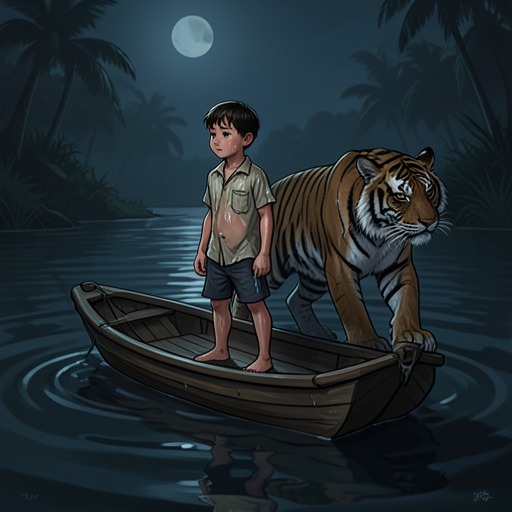
Pi Rescues Richard Parker, Then Jumps into the Sea
Life of PiPi’s rescue of Richard Parker as Tsimtsum sinks turns an apparent act of deliverance into an immediate confrontation with danger: Pi cannot leave the tiger to drown, but bringing him aboard places a powerful predator beside him in the Lifeboat. The sequence makes rescue and self-preservation inseparable, ending with Richard Parker aboard and Pi overboard.
The Shipwreck and the Discovery
The episode begins amid the sinking ship’s noise and disappearance. Pi describes a sound like a monstrous metallic burp, followed by things bubbling at the surface and vanishing. The sea, wind, and his own heart seem to scream together. In rain that makes it difficult to see, he notices something in the water and recognizes Richard Parker’s head above the surface. The tiger is struggling to stay afloat.
Pi’s first response is not to calculate the danger of bringing a tiger close. He calls to Richard Parker, urges him to swim toward the Lifeboat, and sounds the whistle to guide him. His appeal is at once practical and emotional: the distance, he insists, is not great, and Richard Parker is a strong swimmer. Yet the scene has already broken open the world Pi knew. The ship and the life aboard it are vanishing, while the animal he addresses is suddenly a vulnerable figure in the water.
As Richard Parker swims toward him, Pi sees him look panic-stricken and small. The tiger’s diminished appearance does not make him safe; it registers how exposed even this formidable animal is in the open sea. Pi’s narration also turns toward the loss surrounding the wreck. He wonders what has happened to the animals and to the people and life he values, naming Ravi Patel, Pi’s father, and Pi’s mother among those from whom he is separated. The rescue attempt therefore unfolds inside a larger shock: the immediate effort to keep Richard Parker alive is set against Pi’s sense that his former life has been destroyed.
The Lifebuoy and Pi’s Resolve
A lifebuoy attached to a rope gives Pi a concrete means of helping. He takes it and waves it toward Richard Parker, who is now barely keeping his head above water and looking up at the sky. Pi tries to throw the buoy, but it falls short. Even so, its appearance gives Richard Parker hope: he revives and begins beating the water with vigorous, desperate strokes. Pi calls out instructions about breathing and watching the waves while sounding the whistle again.
The scene makes Pi’s determination bodily rather than calm or assured. He says that grief has chilled his heart and made him feel ill, but there is no time to remain frozen. Some part of him refuses to give up on life and keeps fighting, though he cannot explain where that resolve comes from. His efforts to rescue Richard Parker occur alongside his own struggle to respond actively to catastrophe. The buoy’s failed first flight does not end the attempt; Richard Parker’s renewed strokes make another try possible.
Pi throws the lifebuoy again, this time with force. It lands directly in front of Richard Parker, who reaches for it with his last energies and takes hold. Pi pulls on the rope and imagines that, within seconds, the tiger will be aboard and they will be together. That prospect immediately changes the meaning of the rescue. The word together, first framed as the desired result of keeping Richard Parker alive, brings Pi to recognize what sharing the boat with him would mean. The danger was not postponed until the tiger reached the Lifeboat; it was contained in the success of the rescue itself.
The Reversal: Rescue Becomes Escape
Once Pi recognizes the threat, he changes course abruptly. He yanks the rope and orders Richard Parker to let go, then tries to make him leave the Lifeboat’s vicinity. The reversal is stark: Pi has just spent the scene directing the tiger toward safety, but now tries to prevent him from coming aboard. His response is no longer a call to swim toward him but an attempt to keep the animal away.
Pi grabs an oar and thrusts it toward Richard Parker, intending to push him back, but misses and loses hold of it. He takes another oar, puts it in an oarlock, and pulls hard in an effort to move the Lifeboat away. The maneuver fails to achieve its purpose: it turns the boat slightly and brings one end closer to Richard Parker. Pi raises the oar to strike him on the head, but the tiger moves too quickly. He reaches up and pulls himself aboard.
Richard Parker’s arrival is described through the details that make his vulnerability frighteningly temporary. He is wet, trembling, half-drowned, heaving, and coughing; Pi identifies him as a three-year-old adult Bengal tiger. He rises unsteadily on The tarpaulin, then faces Pi with blazing eyes, ears laid tight against his head, and his weapons ready. The head Pi had seen in the water now fills the boat’s space, its size and color compared to the lifebuoy, but with teeth. What had seemed like a rescue of a drowning animal has brought the danger of the tiger into immediate reach.
Pi Overboard and the Scene’s Significance
Pi’s final action is to turn away, step over the zebra, and throw himself overboard. The sequence therefore ends not with a stable rescue but with a reversal of positions: Richard Parker is aboard the Lifeboat, and Pi is in the sea. The Lifeboat offers survival from the wreck, yet its limited space makes the tiger’s presence a new and urgent threat. Saving Richard Parker does not remove danger; it relocates it.
The episode’s force comes from the short interval between compassion and alarm. Pi first treats Richard Parker as someone who can hear his encouragement, follow the whistle, and grasp the lifebuoy; when he realizes that the tiger will be with him, he tries to withdraw the very help he has offered. Neither response erases the other. The act of rescue is real, as is Pi’s effort to escape its consequence. By ending with Pi leaping into the water, the scene establishes the perilous arrangement that will shape their survival together: the animal Pi helped save has reached the boat, while Pi must find a way to survive beside him.